
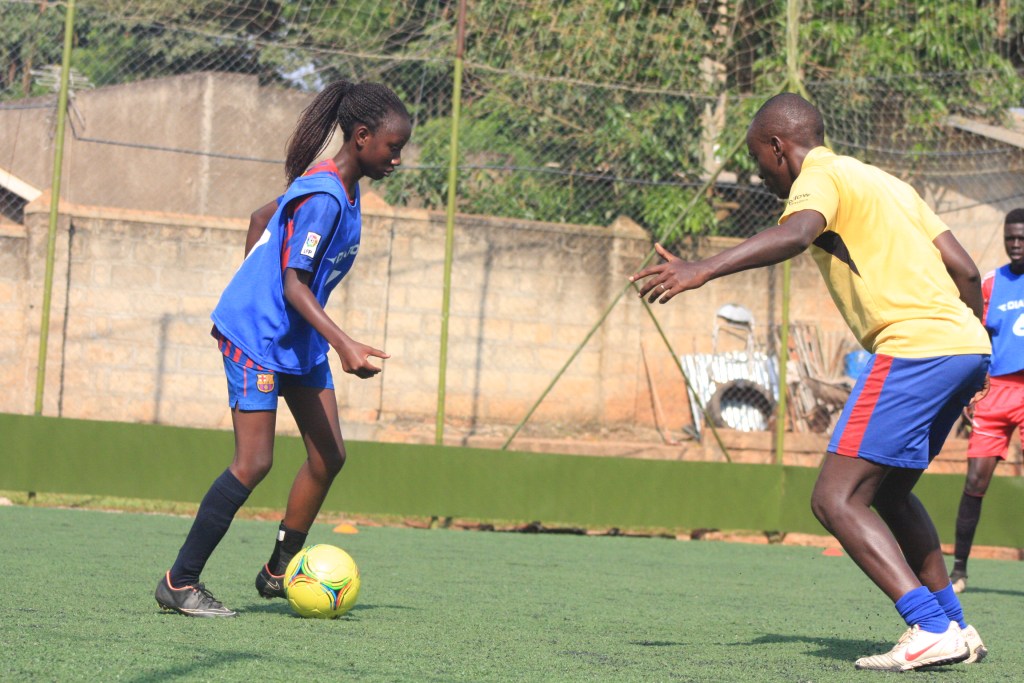
When a team concedes too many goals, coaches often blame the defenders’ effort or size. More often, the players were never deliberately taught what to do, when, where, why and how once the ball is lost.
A principle is a known way of behaving that every player understands. Here are the five defending principles I teach, the problem each one solves, and a way to train it.
First, a warning: principles depend on technique. Make sure your players have the basic defensive skills of tackling, blocking, intercepting and heading before you build these principles on top.
1. Immediate chase: “Pressure the ball now”
The problem: when the ball is lost, everyone stops and the opponent has time to pick a pass.
The principle: the nearest player pressures the ball straight away, cutting down the attacker’s space and time.
Try this: in a 5v5 possession game, a team that loses the ball scores a point if it wins it back within five seconds.
2. Delay: “Slow them down”
The problem: the first defender dives in, gets beaten, and the attack runs at an unorganised back line.
The principle: the pressing defender’s job is to slow the attack so teammates can recover and organise. Jockey, poke at the ball and backpedal rather than lunge.
Try this: 1v1 channel. The defender wins by stopping the attacker reaching the end line within eight seconds, not by tackling.
3. Depth (Cover): “Someone behind the presser”
The problem: one pass or one dribble beats the presser and there is nobody behind them.
The principle: teammates position themselves behind the pressing defender, at a sensible distance, ready to step in if the presser is beaten. The covering player talks to the presser and tells them which way to show the attacker.
Try this: 2v2 in a narrow grid. Stop play whenever the second defender is level with the first, and ask them to find the covering position.
4. Compactness: “Stay together, stay central”
The problem: defenders are spread out and attackers run straight through the gaps.
The principle: recover toward the area of the ball and stay central. A compact team forces attackers to take longer routes around the outside, away from goal.
Try this: use cones to mark three vertical zones. When the ball is in one wide zone, no defender may be in the opposite wide zone.
5. Control and restraint: “Stay on your feet”
The problem: a mistimed tackle gives away a free kick, a penalty or a clear run at goal.
The principle: defenders control their aggression. Stay on your feet unless you are confident you will win the ball.
Try this: in any small-sided game, a sliding tackle that misses the ball gives the attackers a penalty. Players learn patience quickly.
Your checklist for the next match
When your team loses the ball, ask:
- Did the nearest player press immediately? (Immediate chase)
- Did the presser slow the attack instead of diving in? (Delay)
- Was someone covering behind the presser? (Depth)
- Did we squeeze toward the ball and stay central? (Compactness)
- Did we stay on our feet? (Control and restraint)
The takeaway: good defending is organised behaviour, not just hard work. Teach the skills first, then these five principles, and your team will concede fewer goals.
Which of these principles does your team find hardest? Share it in the comments, and subscribe to get the next coaching post by email.
Related: Principles of attack in football · Football: Roles in defense


Leave a Reply