

In Ugandan football we have a familiar problem. When a team attacks, every player gets attracted to the ball, every player asks for it out loud, and every player wants to be on the ball at the same time.
The result is a crowd around the ball, no space, and an easy afternoon for the defence.
The fix is teaching players that during an attack, every player has a role, on the ball or off it. There are three.
Teach these roles after your players understand the principles of attack.
Role 1: The player on the ball (first attacker)
Their job: keep possession, then decide whether penetration is possible by playing forward.
That could mean passing forward, shooting, throwing, or travelling with the ball into space. If they face a defender 1v1, they can improvise and use creativity to beat them.
Role 2: The supporting player (second attacker)
Who: the players within one pass of the ball.
Their job: create the right distance and angle to receive the ball. The basic way is to offer support forward, sideways and backward, depending on where the player on the ball is.
The more support the player on the ball has, the more threatening the attack becomes.
Role 3: The unbalancing player (third attacker)
Who: players usually more than one pass away from the ball.
Their job: unsettle the defence. Move off the ball into dangerous space, or drag defenders away to create space for teammates. This player provides the width and mobility in the attack.
How the roles connect to the principles
| Role | Principle |
|---|---|
| Player on the ball | Penetration or improvisation |
| Supporting player | Support (depth) |
| Unbalancing player | Width and mobility |
Watch it done well
Watch Belgium v Japan at the 2018 FIFA World Cup and ask your players:
- What does the Belgian goalkeeper do when he gains possession?
- How does Kevin De Bruyne react to get the ball, and what does he do with it?
- What do Hazard, Meunier, Chadli and Lukaku do as De Bruyne travels with the ball?
- What does Lukaku do so that Chadli can score?
Try this: 3v2 with a “no crowding” rule
Mark a channel about 30m long and 20m wide with a small goal at one end.
- Three attackers play against two defenders.
- Only one attacker may be within 5m of the ball at any time.
- Freeze play whenever two attackers are close together, and ask: “Who is first, second and third attacker right now?”
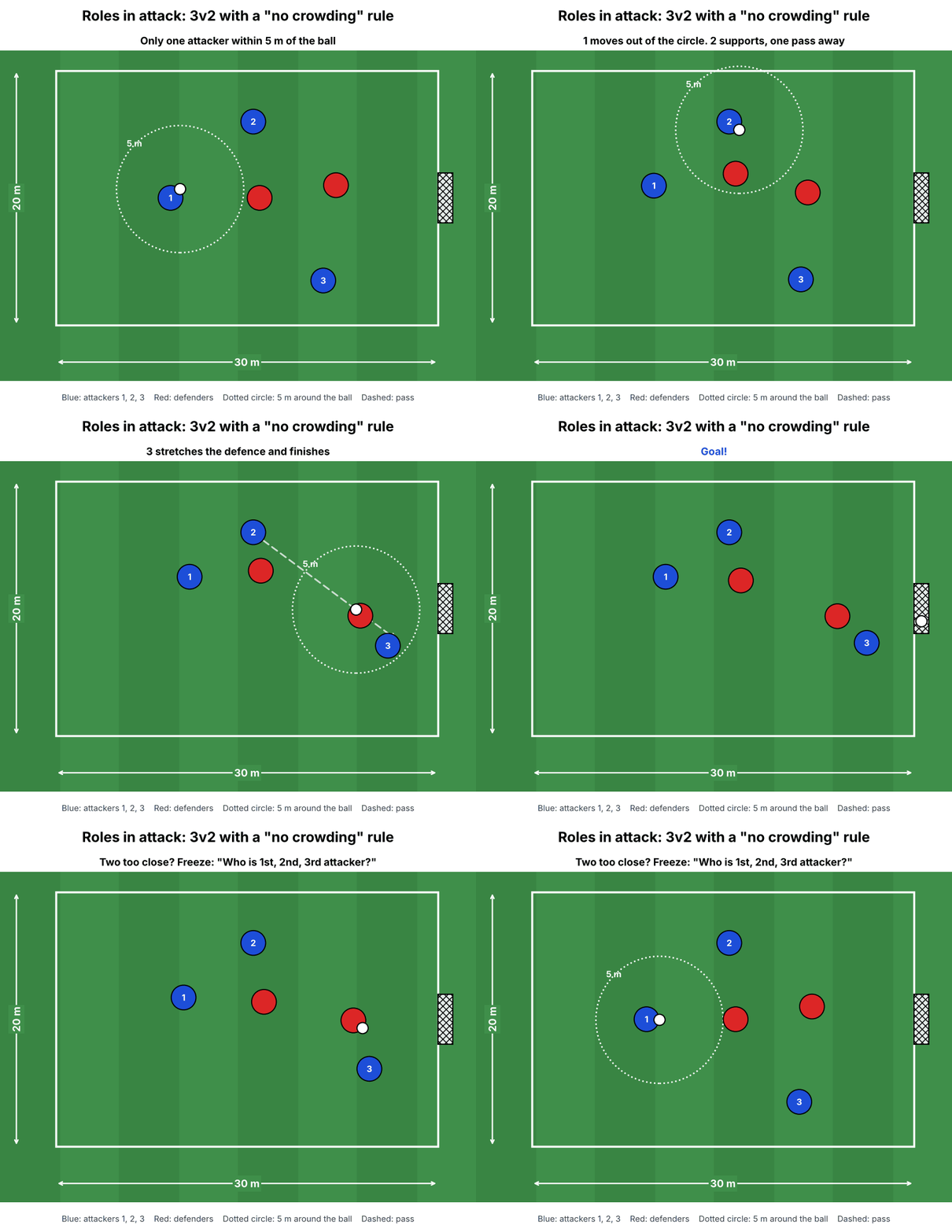
Players learn quickly that space comes from spreading out, not from shouting for the ball.
Your checklist for the next match
- Did the player on the ball look forward first?
- Did they always have a supporting option within one pass?
- Was someone moving off the ball to stretch the defence?
- Did we avoid crowding the ball?
The takeaway
All players should learn the attacking skills (shooting, travelling with the ball, attacking headers, passing and receiving), because at any moment they could be the first, second or third attacker. Players who understand the roles build attacks efficiently and make the most of every overload.
Does your team crowd the ball? Tell me in the comments, and subscribe to get the next coaching post by email.
Related: Roles in defence · The four moments of football


Leave a Reply