
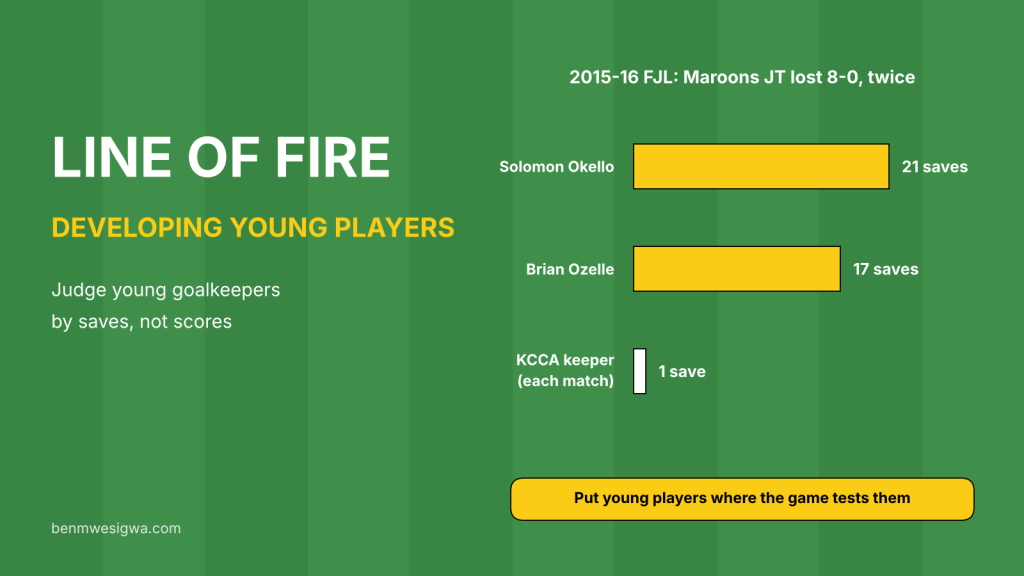
During the 2015-16 FUFA Juniors’ League (FJL), I was coaching Maroons Junior Team. We lost 8-0 to KCCA Junior Team. Then we lost the reverse fixture 8-0 too. To make matters worse, KCCA JT was using the Maroons pitch for its home matches.
Losing those two matches was the least of my concerns.
I used a different goalkeeper in each match because I needed both of them to gain experience. They got more experience than I had hoped for. On top of conceding eight goals, they were ridiculed by their own peers, which is also part of football learning.
Goalkeepers are the clearest example, but this is about every young player.
The numbers that matter more than the score
When I checked the statistics after the matches, Solomon Okello had made 21 saves. In the reverse fixture, Brian Ozelle made 17. The KCCA goalkeeper made one save in each match.
For a young player, every challenge the game throws at them is a learning activity. For a goalkeeper, that is every ball the opponent sends at them. The more activities, the higher the chance of developing earlier. A young player in a team that dominates every match does not get those activities.
Conceding eight goals is hard to take, especially in Uganda, where we want to win junior tournaments at all costs and treat losing as the definition of failure. It shouldn’t be that way in underage football, which should be a development platform for players.
Where were they in 2019?
That KCCA Junior Team went on to send players to the senior team: Paul Willa, Mustafa Kizza, Allan Okello, Peter Magambo, Herbert Achai and Ronald Kikonyogo, among others.
In 2019, Solomon Okello and Brian Ozelle were in Jinja for the Copa Coca-Cola tournament, representing Amus College and Nakaseke International.
Don’t label them as failures. They were never close to failing.
How the big clubs do it: loans with a purpose
In professional football, it is very hard for young players to break into the senior team at top clubs. Those clubs are under pressure to win now, so they rely on experienced signings.
So young players are sent out on loan, and the loan is never random. Clubs break down how the player needs to develop:
- A defender goes to a club where he will face lots of attacking pressure and do lots of defensive work.
- A goalkeeper goes to a club where he will be worked hard in matches.
- The club’s situation is chosen too. Does the player need experience of fighting relegation? Of chasing promotion?
All of this prepares the player for the parent club, or raises his value if he is sold.
Back to Uganda: Humphrey
In January 2019, I played in the Futsal Uganda Cup for Thunders FC. Our goalkeeper was 14-year-old Humphrey Oyirwoth.
After we were eliminated, I started looking for an FJL club where he could develop. My first thought was KCCA FC’s junior team. Then, talking with his older brother, I asked myself: should Humphrey go to a team that completely dominates opponents? Does a goalkeeper develop without being worked in a match?
I decided he needed an FJL underdog, a team that would face KCCA JT, Vipers JT and Onduparaka JT and leave him in the line of fire. Even better, the FJL now has three rounds instead of two, so he could face KCCA JT three times.
The challenge was that I didn’t know a single coach in Uganda who would put a player’s development ahead of matchday results. I would have used him at Maroons JT myself, but I was dismissed as coach there after a 10-0 loss to Onduparaka JT in February 2018. (You read that right: ten-nil. I am still not bothered by that result.)
What to do
If you coach a junior team:
- Count the work, not just the score. After every match, record what each young player had to deal with: the shots a goalkeeper faced and saved, the duels a defender fought, the times a midfielder received under pressure. Judge their match on that.
- Share minutes on a plan. If you have registered three goalkeepers, or several players for any position, write down before the season which matches each will play. Give the toughest fixtures to the one who most needs the work.
- Protect them after a heavy defeat. Talk to the players the same day. Show them their numbers, like a goalkeeper’s save count. Tell the team, too, that ridiculing a teammate after a defeat stops now.
If you are placing a young player (as a parent, agent or coach):
- Choose the club by how much work the player will get, not by its badge or league position.
- Ask the coach one question: “Will he play even if we lose?” If the answer is no, keep looking.
- Plan the next step at the same time. If he joins a dominant academy, ask how he will get match minutes elsewhere, on loan or with a lower-level team.
In training, recreate the line of fire: play small-sided games where one team is a player down. Its goalkeeper and defenders will face far more attacks than in an even game.
The takeaway
A young player learns from the work the game gives them, not from the results their teammates earn. Goalkeepers show it most clearly: judge them by saves, not by scores. Put your young players where the game will test them.
Do you know a coach who would put a young player’s development ahead of a matchday result? Tell me in the comments, and subscribe for more on developing football in Uganda.
Related: Winning or development? · Laws of the game: Worry for Ugandan football


Leave a Reply