
Ask a scientist what science is, and they’ll tell you, because it’s the first thing they were taught. The same goes for geography, medicine, biology or art.
Ask a football coach what football is, and many will struggle. Yet football coaches need to understand football, because it’s what they coach.
What is football?
Football is a highly tactical team sport based on teamwork and opposition. It involves social skills (working together and respecting hierarchy) and motor skills (movement of the limbs).
FIFA recognises three forms with a World Cup: football (eleven-a-side), futsal and beach soccer.
Five things that make football what it is
- It’s competitive. Two teams oppose each other, and the competition grows when there’s a trophy, a place in the team or a squad selection at stake.
- It has objectives. The first objective of any match is to win: attack to score, and defend so you don’t concede.
- It has laws and regulations. The Laws of the Game, updated by IFAB every year, keep it fair. Competition regulations explain how to handle situations during a competition.
- It’s free-flowing and multi-directional. Once the referee starts the match, it hardly stops until the permitted breaks. Possession changes without stopping play, players aren’t restricted to areas, and a goal can be scored or the ball lost in any direction.
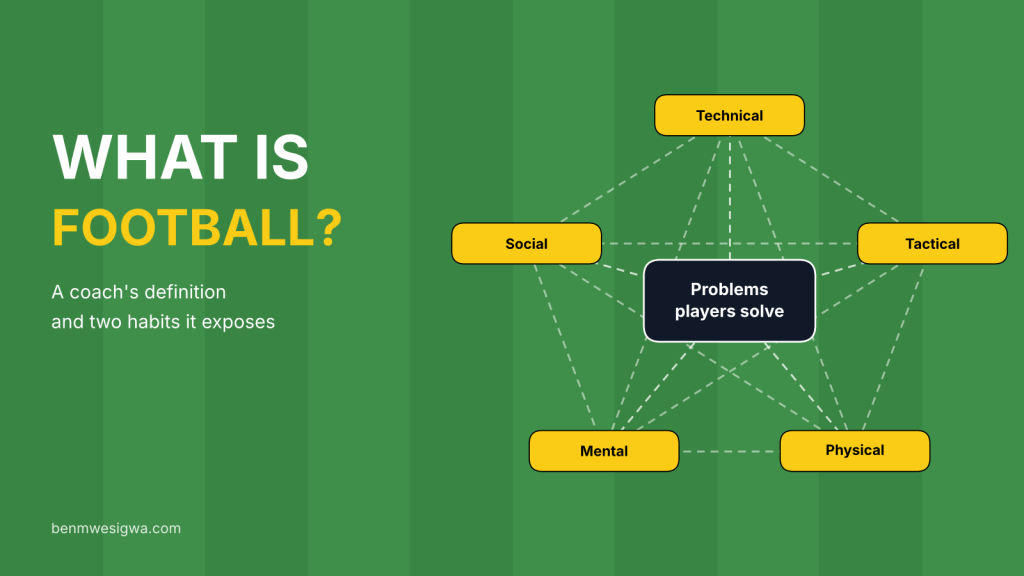
- It presents problems that players must solve.
The problems football presents
| Type | Example questions players must answer |
|---|---|
| Technical | How do I dispossess an opponent? How do I pass to a teammate 60m away? How does the goalkeeper handle a high cross? |
| Tactical | How do I shoot from a tight angle? How do I defend 1v1? Should the goalkeeper distribute 5m or 60m? |
| Physical | Can I change direction quickly? Can I leap on time? Can I still do it in the 90th minute? |
| Mental | Can I concentrate? Can I take in information? Can I control my emotions? Am I committed to high standards, whatever the result? |
| Social | Will I work for my teammates? Do I put the team ahead of myself? |
As a coach, your training session must present one or more of these problems. Otherwise, you aren’t coaching football.
Two Ugandan coaching habits that go against the game
Habit 1: The “hot cake” ball
The problem: in training, the ball is almost never out of play. As soon as it rolls over a line, someone plays it back in, as if it were a hot cake. In a match, the referee clearly stops play when the ball goes out. Players carry the training habit into matches and complain about the referee.
The fix: in training, use clear lines, and restart properly with throw-ins, goal kicks and corners. Treat the ball going out as part of the game, just like in a match.
Habit 2: Solving the players’ problems for them
The problem: coaches tell players where to pass, warn them about opponents and give endless instructions on what to do and not to do. Players never learn to solve problems themselves, so they struggle when the tempo is high or the stadium is too noisy to hear the coach.
The fix: design practices that present the problem, then let players solve it. Coach with questions (“What did you see? What else could you do?”) instead of commands. During matches, say less.
Your checklist for the next session
- Does my session present a technical, tactical, physical, mental or social problem?
- Do players restart the game properly when the ball goes out?
- Am I letting players solve problems, or solving them for them?
The takeaway
Football is a game of problems, and players are the ones who must solve them. Coach the game as it really is, and let your players do the thinking.
Which of these habits do you see most often? Tell me in the comments, and subscribe to get the next coaching post by email.
Related: Factors affecting football performance · The four moments of football


Leave a Reply