
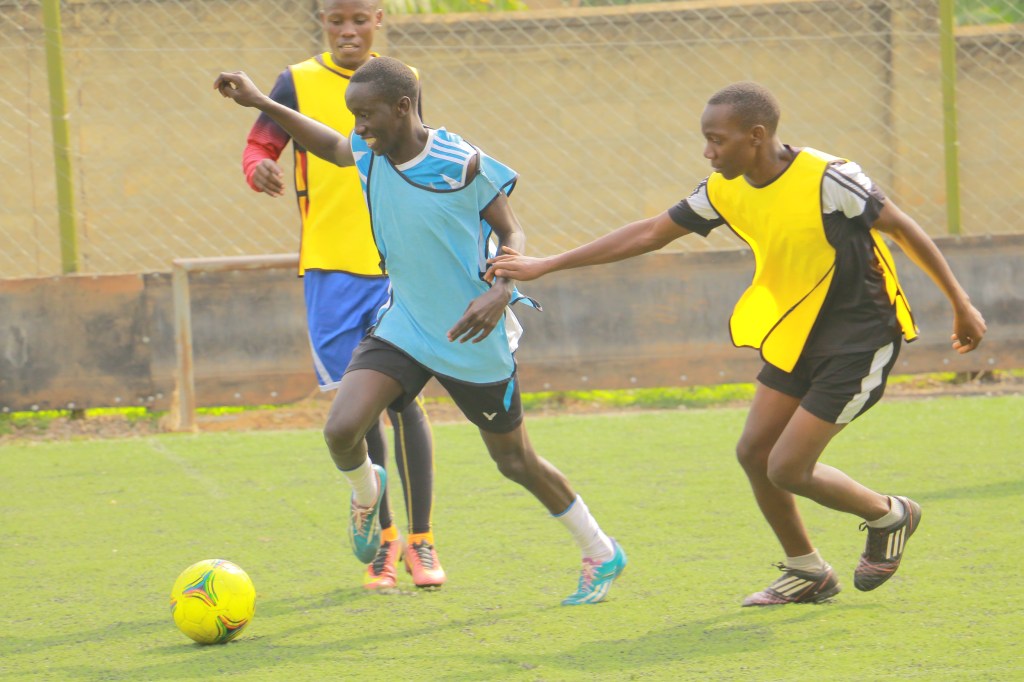
Every team has one: the player who wins every sprint race in training, yet always seems to arrive a second too late in a match.
That’s because football speed is not a 100-metre race. It depends on the movement of the ball, the opponent and your teammates. There are three kinds of football speed, and your players need all of them.
| Type | What it includes |
|---|---|
| Physical speed | Pure speed, acceleration, deceleration |
| Technical speed | How quickly a skill is executed |
| Mental speed | Perceptual, awareness, anticipation, cognitive and reaction speed |
Physical speed
Pure speed is running from one point to another in the shortest time. A good 100m time is nice, but footballers rarely run that far. Most sprints in football are between 0 and 40 metres.
Acceleration and deceleration are how quickly a player can speed up or slow down. This is a big part of agility and wins 1v1 situations, in attack and defence. It needs quick footwork, powerful muscles, a strong core, and strong, mobile hips, knees and ankles.
Both depend on good body coordination.
Technical speed
Everybody can receive, pass, shoot and head. High-level footballers do it in the shortest possible time without losing accuracy.
Technical speed is learned through individual practice, then improved under pressure in matches. Small-sided games are the best way, because players repeat actions more often in less time.
Mental speed
- Perceptual speed: looking up, interpreting what’s happening and deciding. About 85% of it comes through the eyes, the rest through hearing. As a player receives the ball, do they already know whether to pass, shoot or dribble?
- Awareness speed: knowing where the ball, opponents, teammates, space, score and time are. The basic habit is looking over both shoulders when off the ball.
- Anticipation speed: knowing what will probably happen next, like timing a run for a cross or a goalkeeper coming for a high ball. It comes from experience, especially small-sided games during the development phase.
- Cognitive speed: recognising a problem and choosing the quickest solution. In a 2v1, both attackers and the defender must solve the problem fast. It’s helped by puzzles, board games like chess, and non-violent video games.
- Reaction speed: responding to the ball as it changes hands. It improves through small-sided games, once players know their skills and the principles of attack and defending.
Try this: three simple speed tests
Coaches should track how players score in speed tests so they keep improving. Test every few months with cones and a stopwatch.
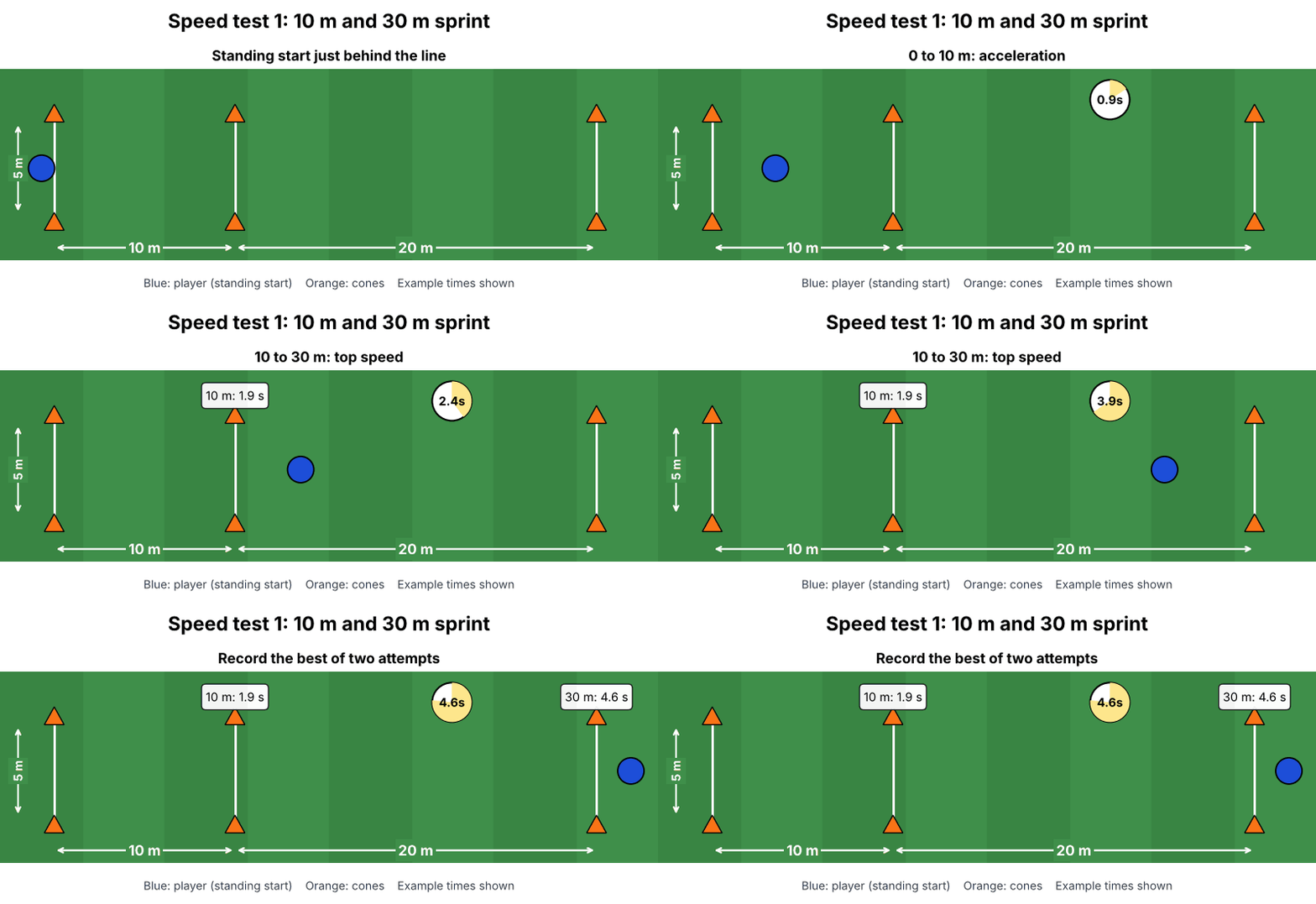
- 10m and 30m sprint (acceleration and pure speed): time from a standing start. Record the best of two attempts.
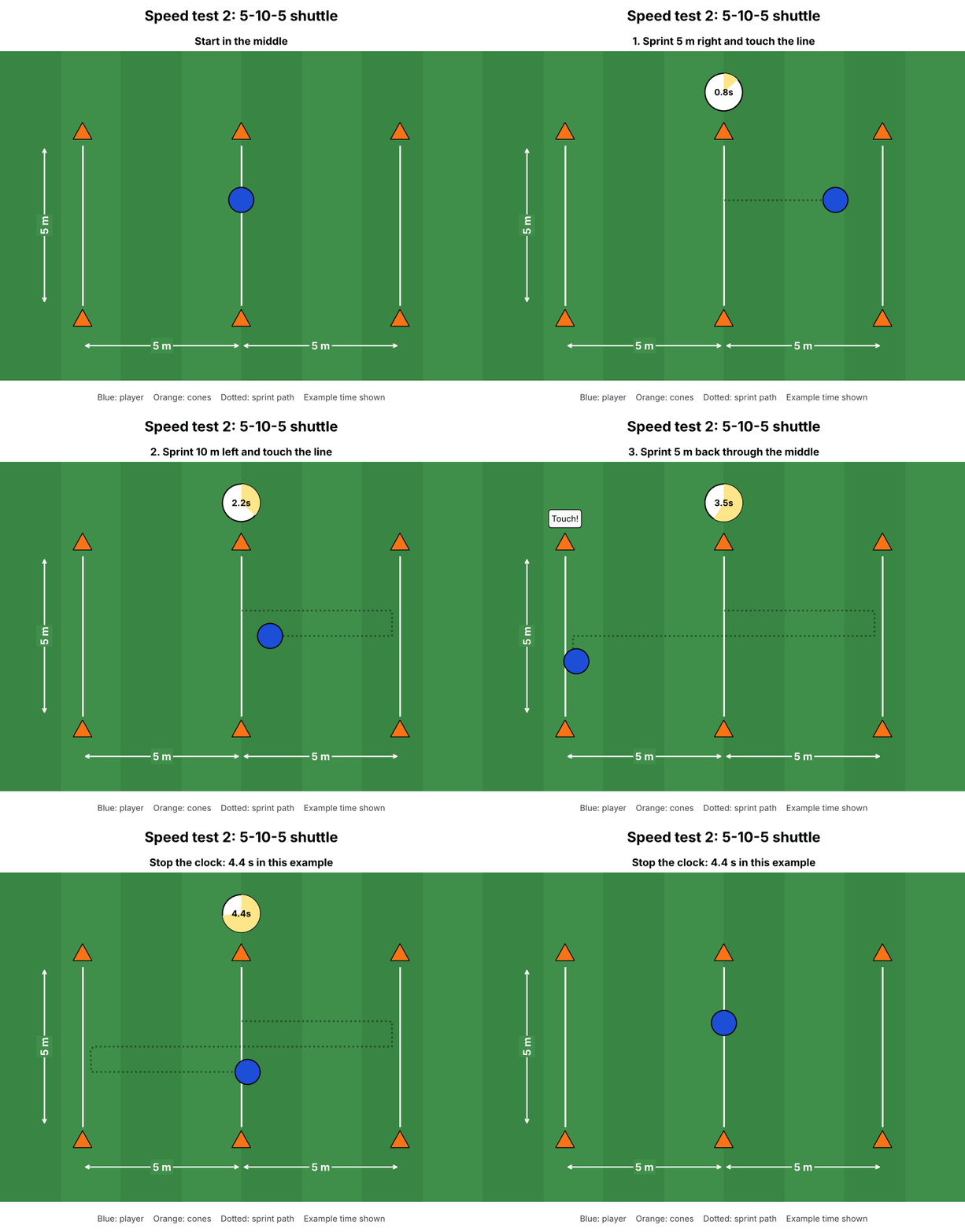
- 5-10-5 shuttle (acceleration, deceleration and agility): run 5m right, 10m left, 5m back to the middle, touching each line.
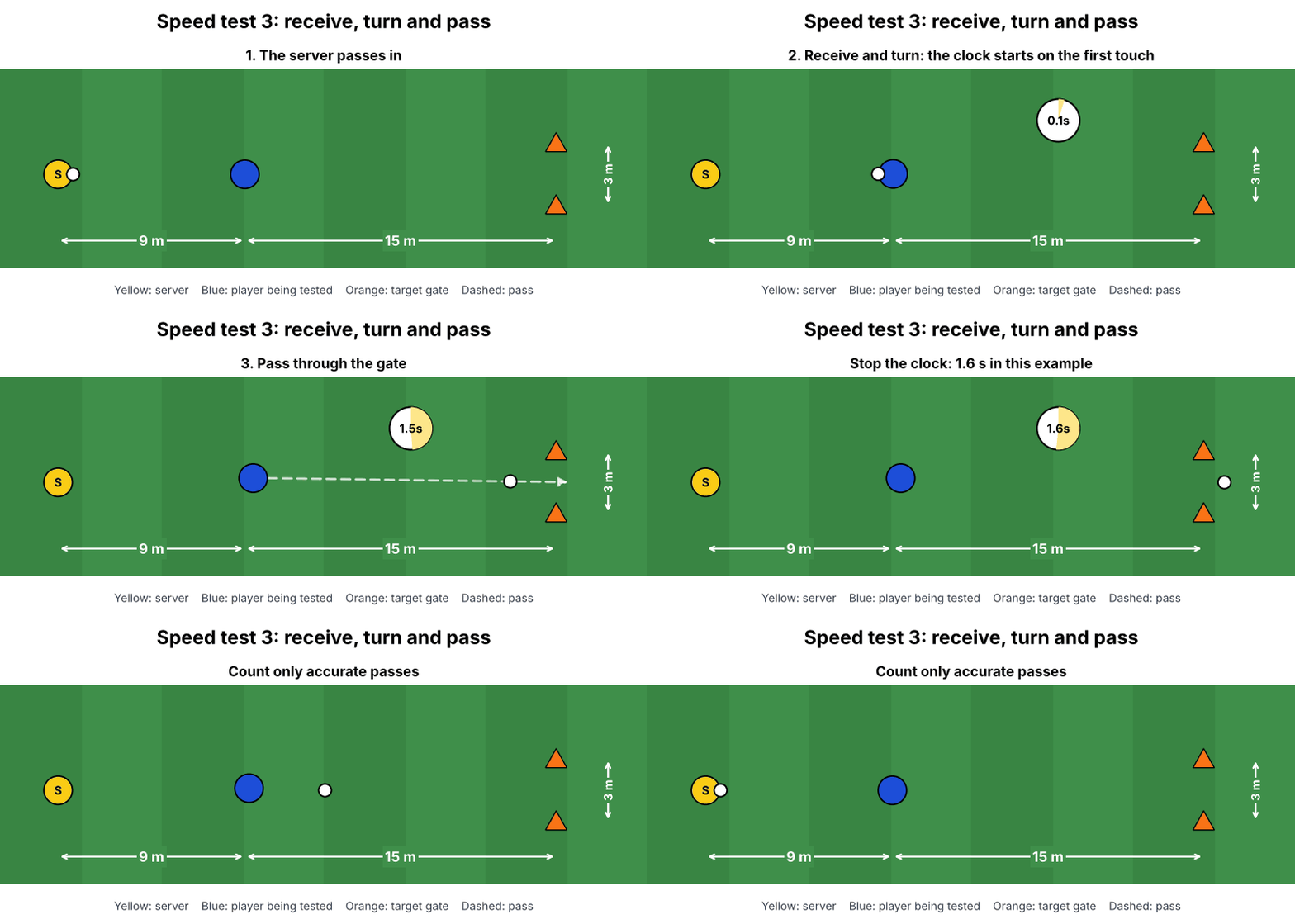
- Receive-and-pass test (technical speed): time how long it takes to receive a pass, turn and hit a target 15m away. Count only accurate passes.
For mental speed, play 4v4 where a goal only counts if the scorer looked over their shoulder before receiving.
What else affects speed
- Mental speed depends on concentration, developed from a young age through good nutrition and good sleep.
- Physical speed depends on body coordination.
- Technical speed depends on coordination, time spent practising with the ball, and time in small-sided games or street football.
The takeaway
Don’t judge speed only by who wins the sprint. Train and test all three kinds, and your players will start arriving first.
Which type of speed do your players lack most? Tell me in the comments, and subscribe to get the next coaching post by email.
Related: The four moments of football · Coordination


Leave a Reply