The four moments of football.

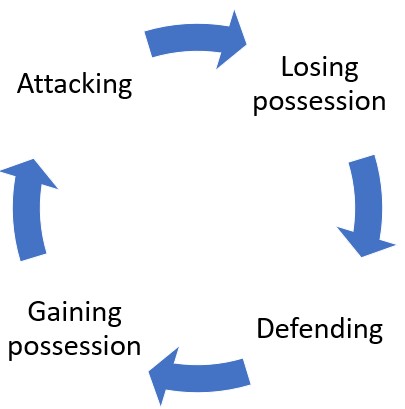
Football has four moments that keep occurring throughout a match.

These are; In possession, losing possession, out of possession and gaining possession.

These moments are separate and can only happen one at a time for a given team.

The best players that make it to the top level, know and understand how to behave in all these four moments.

In possession is attacking, out of possession is defending while gaining possession and losing possession are known as transitioning.

In possession: The team in possession of the ball is the attacking team. Players in the attacking team are expected to behave by applying the principles of attack and roles in attack.

The efficiency of an attack is determined by how well individual players in a team are comfortable at executing attacking football skills.

Out of possession: The team out of possession is the defending team. Successfully defending an attack in football requires individuals in the team applying the principles of defending and the roles of defending.

This requires the individuals being able to execute all football defending skills comfortably.

Transitioning: Losing or gaining possession happens at the same time.

As one team gains possession, the other team is losing possession.

The faster the transition, the better the outcome.

If a team gaining possession transitions faster than the team losing possession, then attacking will have the desired effect.

If a team losing possession transitions faster than the attacking team, then defending will have the desired effect.

Players with excellent football speed transition better.

The higher the level of football, the higher the demand to have better football speed to perform with quality during transitions.

Top teams in modern football are capable of transitioning under five seconds if the ball is won or lost at the halfway line.

It’s important for football coaches to ensure that players are taught how to comfortably execute all football skills irrespective of playing position because modern football dictates that every player gets involved in all the moments of football.

The four stages of skill acquisition.

A skill is a learned ability. Its something you need to execute a task.

Learning any skill is easy but mastering a skill takes time, commitment and discipline.

Mastering a skill is what sets you apart from ordinary people.

It’s important for footballers to master football skills until they can be performed with quality and spontaneously.

It’s believed that it takes 10,000 hours of DELIBERATE practice before the age of 20 to master a skill, during that time, you the will have to go through the following stages;

Unskilled, Unconscious; In this stage of skill acquisition, you have no idea about the skill and how its executed.

It’s safe to say that you are ignorant about it. If you do it then chances are that it’s done by mistake and can’t be sustained.

Before teaching players the steps of how to pass the ball, most of them will play football and perform the skill.

The passing is poor quality and players are unconscious of the right steps required to execute a proper pass.

Unskilled, Conscious; This’ the second stage of skill acquisition.

Now we assume players have been taught how to pass the ball.

Players will have classroom lessons and gain consciousness of the steps required to pass the ball like; making eye contact with the recipient, non-kicking foot standing beside the ball, pointing where you intend to pass, following through with the foot that strikes the ball and the other steps required when passing the ball.

In this stage of skill acquisition, you will know what is required to perform a skill but won’t be skilled to pull it off because you haven’t yet practiced enough.

In some cases, the skill is performed but under little or no pressure at all.

Expect a lot of mistakes in this stage

Skilled, Conscious; This’ the third stage of skill acquisition. In this stage you know how to execute the skill, you know what it takes to pull it off and that is what mainly preoccupies your mind.

During practice, you get static every time you miss a step or whenever you make a mistake you instantly recognize why/how you made the mistake.

You are conscious. The brain knows what you need to do but the body/muscles are yet to synchronize with messages from the brain.

This stage of skill acquisition requires a lot of positive feedback from coaches and peers.

Skilled, Unconscious; This’ the last stage of skill acquisition. In this stage, you can execute a skill like passing the ball, you do it so well to a point that you don’t have to think (unconscious) about the steps required.

At this stage every step in skill execution is spontaneous.

Eye contact before passing the ball is now shorter, the non-kicking foot easily gets besides the ball in the required distance, the non-kicking foot points very well while passing the ball.

At this stage, mistakes are treated as a one-off but with disappointment in yourself.

Most footballers don’t get to the last stage of skill acquisition mainly because of poor coaching standards.

Young footballers should be taught skills in a no-pressure environment to give a high chance of success.

Pressure can always be increased when a player has achieved a certain level of success.

Football: Roles in defense.

When a team is not in possession of the ball, it’s the defending team.

All players in the defending team should be able to help out with defensive duties.

The roles in defense are; pressuring defender (first defender), covering defender (second defender) and the balancing defender (third defender).

Its important that football players are taught the roles of defending after understanding principles of defending.

Pressuring defender (first defender); this’ the player closest to the ball, the role of the first defender is to apply pressure on the ball.

Pressing the ball helps to delay the attackers by denying penetration, forces them into mistakes and if possible then wins the ball to regain possession.

The pressuring defender’s other roles include selecting the proper angle and speed of challenging for the ball.

Covering defender (second defender); this’ the player closest to the pressuring defender.

The second defender’s role is to offer cover to the pressuring defender.

The covering defender should always be positioned between the pressuring defender and the goal they are defending.

The distance has to be appropriate enough to enable the covering defender to react fastest to the ball in case the pressuring defender is beaten.

The covering defender should be able to communicate verbally with the pressing defender.

“A good defender is verbally loud.”

Balancing defender (third defender); The role of the third defender is to balance the defense by maintaining compactness or tracking attackers running off the ball.

The balancing defender should be able to maintain sight of the ball, have a clear vision of the whole pitch and to communicate verbally with the covering defender.

The roles performed by defending players are within the principles of defending. The pressuring defender performs immediate chase or delays the attacker. The covering defender offers depth while the balancing defender creates compactness.

It’s very important for all players to be capable of executing football defensive skills because at one point they will find themselves defending as a first, second or third defender.

Developing the Uganda Premier League.

Uganda Premier League (UPL) has been developing with every passing year since Bernard Bainamani took over as C.E.O. Every other season shows improvements.

This particular season 2017-18 has been better in terms of competitiveness. For the first time in a very long time, you find fans debating which team will be relegated and who will be champions. However, it will be a very huge mistake for UPL and its stakeholders to think of this competitiveness as an indicator for a developing league.

UPL’s competitiveness can mainly be attributed to the Federation of Uganda Football Associations’ (FUFA) move to introduce prize money and starting a top 8 tournament that will have prize money too, you can consider that as double prize money.

UPL has lots of challenges like; matches not kicking off on time, match reports not being accurate, fan violence not being checked, inconsistent officiation not being investigated, poor quality playing surfaces, players and coaches not understanding the rules, regulations and laws of the game, lack of ambulances at playing grounds, fixture congestion, league not starting on scheduled time, having unauthorized personnel within the perimeter fence during matches and on the pitch after league matches, league licensing requirements not being followed promptly, to mention but a few.

It’s important to note that although most of these challenges are societal problems that can’t be solved in a very short time, they are some of the minor details that are required to develop a league into a professional brand.

Development has no short cuts, requires ruthlessness too

For UPL to develop at a normal rate, all the stakeholders involved in Ugandan football will have to agree that their capacity is still very low. Stakeholders are; highly qualified coaches of different specialties, sports medicine personnel, match day officials, football administrators, media, players and fans. Having fewer qualified stakeholders running the game of football at the highest level like UPL should call for a reduction in the number of top-flight teams from 16 teams to 10 or 12 teams until we grow the football capacity in terms of quality and quantity of stakeholders.

UPL having twelve teams from sixteen teams would mean having less required but the best of officials, coaches, players, administrators, and media. It would be easier for the fans too but most importantly it would mean more sponsorship money for the fewer clubs to share.

You will never find a developed society that is lenient on certain aspects.

FUFA as the supervisors of league football in Uganda needs to be very ruthless on certain aspects. Club licensing requirements should be much more detailed and have acceptable standards set. Example; what are the playing field measurement dimensions accepted for a pitch to be used in UPL? How does a pitch qualify to be of UPL standards? In this case, I am mentioning pitch but not stadium because a stadium is something that requires a lot of finances that we can’t yet get to but having a quality playing pitch can’t be beyond a UPL club’s current finances.

Every society should have unique ways of solving its own problems. UPL needs creativity

Ugandan football especially UPL is a unique society in its own right, developing will happen when the leaders task the stakeholders involved to document the problems encountered then start coming up with creative ways to solve those problems.

When you mention about UPL having ten or twelve teams, the first response you get is, “those are few clubs in the league, and a professional should play an average of 40 matches in a season”. With our copy and paste syndrome, we forget that a UPL player will be involved in more tournaments like; Clan football, the drum tournament, Uganda Cup, CHAN, underage tournaments for the national team and Super 8 coming up. We forget that we keep exposing them to poor playing surfaces that make it easier for them to get injured.

A 10 team league can creatively have 27 match days, it can also have 34 match days. A twelve team league can have 27 or 32 league matchdays and be very competitive too yet using fewer resources as we work towards growing the capacity of football stakeholders.

The business question to answer would be how UPL teams would be reduced from 16 to 10 or 12 teams which would call for the kind of ruthlessness required to develop. As we head into the 2018-19 season, UPL and FUFA would have to agree on what they would want a UPL club to have, that is to say, set the licensing requirements and standards.

For instance; each club should have a quality playing surface (define what quality is for a UPL playing surface), club operating structures, standard training facilities, set criteria for a number of qualified and specialized coaches and officials, set suspended offense limits e.t.c. FUFA and UPL would then set a timeframe of two seasons and inform clubs that for the 2020-21 season, clubs would have to apply for a license to play in the UPL.

The clubs that will have met the required criteria will play. This should be open to all clubs in the country then watch how clubs out compete themselves to ensure that licensing requirements are met.

For the moment, with our current football capacity, 16 clubs in UPL is a crowd that can’t be efficiently managed to sustain the required rate of football development.

Solidarity payment contribution: FUFA should use it to develop football in Uganda.

Under FIFA regulations on the status and transfer of players, if a professional footballer transfers to another club during the course of a contract, 5% of any transfer fee, not including training compensation paid to his former club, shall be deducted from the total amount of the transfer fee and distributed by the new club as a solidarity contribution to the club(s) involved in training and education the player over the years.

The Solidarity Payment Contribution podcast.

This solidarity contribution reflects the number of years the player was registered with the relevant club(s) between the seasons of the 12th and 23rd birthdays, as follows:

Season of birthday% of compensation% of total transfer fee
12th5%0.25%
13th5%0.25%
14th5%0.25%
15th5%0.25%
16th10%0.50%
17th10%0.50%
18th10%0.50%
19th10%0.50%
20th10%0.50%
21st10%0.50%
22nd10%0.50%
23rd10%0.50%
Total100%5%
The above table is a breakdown of solidarity payment contribution.

According to my financial expert Andrew Muhimbise, passive income is money earned without the direct involvement of the income earner.

Passive income does not mean earning money by doing nothing.

It means generating revenue without having to exchange time for it (beyond the initial time invested in creating a passive income stream).

For instance, owning real estate or company shares, you actually don’t have to physically be there to earn but, to earn passive income, you need an initial effort.

Paul Pogba’s move from Juventus to Manchester United for £89,300,000 helped Le Havre AC to earn £893,000 as passive income.

He joined the club aged 12 for four years. Since they contributed to his development and education as a football player, they earned passive income for their efforts.

Racqui San Isidro who ply their trade in Spain’s fifth division were saved from running out of football business by the solidarity mechanism payment.

Pedro’s £27,000,000 transfer from Barcelona to Chelsea ensured that they earned a lifesaving £320,000 which not only helped them stay in football but ensured they invested the money to increase income to help run the club.

The same cannot be said of football clubs in Uganda.

FUFA SHOULD IMPLEMENT A DOMESTIC SOLIDARITY MECHANISM PAYMENT SYSTEM THAT DEVELOPS UGANDAN FOOTBALL

The solidarity mechanism payment system only applies to international transfers (involves moving from one federation to another federation), Federation Of Uganda Football Associations (FUFA) can implement a domestic version that would STRICTLY apply to DOMESTIC transfers.

In the past years we have seen how Ibrahim Sekagya’s transfer from Arsenal de Serandi to Red Bull Salzburg caused more fist fights than celebrations, with the Austrian club required to pay 5% of the transfer fee, all of Sekagya’s former teams were demanding for payment, reason: they heard that there was payment but, in reality they didn’t know which club qualified for payment.

With a domestic solidarity mechanism payment,

  1. Clubs will be organized and maintain records because they will expect payment from transfers. Handling “small” transfer fees will help prepare clubs for the huge amounts and avoid the issue of Victor Wanyama’s transfer from Celtic to Southampton.
  2. Clubs will work very hard to train and maintain quality players because they will know that it pays to train a “Pogba”. At the moment, we have young players moving every transfer window, the lack of stability denies players a chance to get proper football education and to develop talent.
  3. Clubs will appreciate the value of having full-time standard academies and attaching value to talented footballers. With more transfers and funds being paid to clubs, more money will get to grassroots which helps clubs acquire equipment.
  4. Clubs will work very hard to stay in business by adopting modern business methods. Having the hope that there’s payment because of a good product on the market would keep any club afloat.
  5. The problem of age cheating will be solved because clubs would need to register players from the age of twelve and keep tracking them to avoid missing out on a huge payday.

The most expensive Ugandan footballer has got to be Farouk Miya after Standard Liege paid $400,000 to Vipers.

On applying the solidarity mechanism payment formula, Standard Liege should be paying Friends Of Football (FOF) about $6,000.

Do they have the paperwork to prove he was groomed at their academy?

Do they have the knowledge that they are due $6,000 from Standard Liege?

Why is it that a law that was introduced to develop football at grass root level is not serving its intended purpose?

The biggest move of the 2016-17 Ugandan transfer window was of Musa Esenu joining Vipers SC from Soana FC for a reported 25,000,000 Uganda Shillings.

The 21-year-old striker was groomed by Future Stars in Soroti.

Below is an illustration of how a domestically applied solidarity mechanism payment would benefit Future Stars.

Player Musa Esenu
Registering Club Vipers SC
Former ClubSoanaD.O.B
Instalment25,000,000CurrencyUGX
95% due to Selling Club23,750,000
Solidarity 1,250,000
Season of BirthdayClub% dueAmount
Season of 12th BirthdayFuture Stars 5.00%62,500
Season of 13th BirthdayFuture Stars 5.00%62,500
Season of 14th BirthdayFuture Stars 5.00%62,500
Season of 15th BirthdayFuture Stars 5.00%62,500
Season of 16th BirthdayFuture Stars 10.00%125,000
Season of 17th BirthdayFuture Stars 10.00%125,000
Season of 18th BirthdayFuture Stars 10.00%125,000
Season of 19th BirthdayFuture Stars 10.00%125,000
Season of 20th BirthdaySoana10.00%125,000
Season of 21st BirthdayN/A10.00%125,000
Season of 22nd BirthdayN/A10.00%125,000
Season of 23rd BirthdayN/A10.00%125,000
TOTAL1,250,000

As illustrated above, Future Stars would pocket 750,000 Uganda shillings of passive income from Esenu’s move for their initial effort in grooming him. It sounds like very little money but it’s enough to buy basic football equipment to keep them running.

It would prepare Future Stars to receive bigger amounts should Esenu move from Vipers for a higher transfer fee and most importantly, its better than nothing at all.

The ball is in FUFA’s half to be creative and come up with a domestic solidarity mechanism payment system to help clubs to develop through being able to get funds to the grass root structures that groom football players.

Amending domestic player transfer regulations would do the trick.