Factors affecting football performance.

A footballer’s performance has factors that affect it.

These four factors are; Technical, Tactics, Physical and Psychology (mental).

These four elements are very dependent on each other, they can only be applied in unison. You can hardly apply tactics and ignore technical, physical and psychology.

Technical and tactics are mainly taught by football coaches but learning happens during matches.

Physical is mainly DEVELOPED from a young age (aged 3 to 12) by working on exercises that develop coordination and can also be learned by allowing upcoming footballers (aged 3-12 ) to participate in different sports and fun games, it’s then MAINTAINED in later years of a footballer. (These days even after retirement).

Coordination is responsible for all the physical demands in football.

Psychology (mental) is the most neglected element yet it’s as important as the other three or must-have for better football performance.

Reason? It’s the element that is taught by parents/guardians from a player’s infancy stage to adulthood then improved through coaching.

It’s very much the foundation stage of a footballer’s performance.

Concentration accounts for almost 60% of the mental demands in football.

Technical includes football skills like; passing, shooting, the first touch, heading, dribbling, tackling, marking, handling, diving (goalkeeper) and throwing.

It’s basically the skills that are applied to the ball.

These skills need to be learned and perfected before the age of 20 then developed until they can be applied under the immense pressure of space and time.

Coaches, parents and upcoming footballers should ensure these skills are constantly developed until they can be applied in a pressured environment.

It is important for footballers to learn, master and be comfortable executing all football skills regardless of the playing position.

The quality execution of football skills is affected by coordination.

Tactics are the how, when, where and why the application of football skills or decisions on the pitch.

Quality footballers are able to perform better because they have been taught to answer who does what how when where and why?

Answering those football questions is derived from knowledge and understanding of the principles of attacking and defending in football.

Coaches and parents should ensure that young footballers (aged 6-12) are given the chance to express themselves with the ball and in small-sided fun matches while growing up so that between 12-15 years of age they can start to be taught who does what how when where and why?

Physical includes; agility, acceleration/deceleration, jumping, stamina, balance, flexibility, footwork, strength (power for footballers), pure speed (not to be confused with overall football speed) and natural fitness.

This element is developed from a young age with better nutrition, playing creative fun games and using quality training equipment to develop coordination of the body.

Psychology or metal includes; passion, decision making, teamwork, work rate, enthusiasm, concentration, communication, commitment, confidence, control, creativity, determination, influence, off the ball and composure.

Having those attributes helps a player to be; confident, ambitious, versatile, focus, adaptable, consistent, good and positive attitude, professional in behavior, sportsmanship, bravery, etc.

Parents should put more emphasis on the psychological element in the development stage of a footballer because it requires a lot of time, effort and hard work to instill and can’t be tolerated if lacking in a professional set up.

As mentioned earlier, these four elements all work at the same time and can’t be separated.

Scenario: A defender has a striker bearing down on goal facing her in a 1v1. In that scenario the defender has to track backward with bent hips (physical), has to know when, where on the pitch, how and why a defender tracks backward (tactics), has to focus on the ball and be confident (mental) in her ability to defend then finally might have to tackle (technical) or apply principles of defending.

Principles of attack in football.

A principle is a known way of behavior.

It should be DELIBERATELY taught so that an individual knows and understands what, when, where, why, and how to behave.

Attacking in football is best understood and efficient when player(s) as an individual or group understand how to apply the principles of attack.

These are; penetration, mobility, width, depth (support), and improvisation.

Penetration is moving the ball forward. The moment a player gets the ball, the first choice should be to determine if penetration can be achieved by passing forward, shooting, dribbling, and running with the ball forward.

Mobility is when players move to create space.

A player on the ball can apply mobility by dribbling or running with the ball to commit available space.

Players off the ball should move to destabilize the opposition’s defense, avoid being marked and create space for themselves or their teammates.

Width is using the whole pitch from left to right.

Players in the attacking team should ensure to spread out to make it hard for opposition players to mark them out of the game.

Width helps the attacking team to stretch the opposition’s defense which creates space for the attacking players to penetrate.

Depth (Support): players in the attacking team need to support the player on the ball.

The most important aspect of supporting a player on the ball is the angle, speed (timing), and distance of support.

Distance has to be appropriate, not too short to be closed down by one player, and not too far to make it easy to intercept.

The correct angle of support is making it easier and possible for the ball to get to you within one pass.

Speed of support is taking up supporting positions for the player on the ball in the shortest time possible.

Depth can also be achieved by offering support using the length of the pitch.

“Supporting is one of the most misunderstood principles as most players think that it’s coming closer to the player on the ball.

Improvisation is where a player on the ball needs to come up with a way to mount a successful attack and get out of trouble.

It includes dribbling in 1v1 situations, and buying a foul (which comes with experience), it’s mainly players being creative and applying ‘tricks’.

It can also be applied by teammates in the attacking team using combinations like 1-2 passing, wall pass, or the third man running off the ball.

Football players that have been taught and understand the principles of attack will find it easy to perform the roles of attack during a football match.

It’s important for all players to be taught the attacking skills in football.

These include; Shooting, passing, receiving the ball in all ways, attacking headers, and traveling with the ball because without learning those skills it is almost impossible to execute the principles of attack.

It’s important for players to be coached on how to understand and be able to interpret when in the game a particular principle of attack can be applied.

Principles of defending in football.

A principle is a known way of behavior.

It should be DELIBERATELY taught so that an individual knows and understands what, when, where, why and how to behave.

Defending in football is best understood and efficient when player(s) as an individual or group understand how to apply the principles of defending.

These are; Immediate chase, delay, control, depth, compactness then control and restraint.

Immediate chase: the moment a team loses possession, the nearest player to the ball in the defending team has to apply pressure on the player with the ball.

Applying pressure on the ball denies the attacker space and time, forces the attacker into mistakes and prevents the attacker from looking up to make a good decision.

The player can also make a recovery run to get behind the ball (between the ball and defending goal).

Delay: the pressuring defender forces the attacking team to slow down in order to allow the defending team to re-organize one of the skills required to perform good delaying is jockeying, poking the ball, and peddling backward.

Depth (cover): This’ the immediate organization of the defending players behind the ball (between the ball and goal they are defending) and the pressuring defender.

The defenders offering cover should be positioned within an appropriate distance from the pressing defender to enable them to react fastest in case the pressuring defender is beaten by the attacker.

The covering defender should be able to communicate verbally and issue instructions to the pressuring defender.

Compactness: as defending players recover towards their goal, they have to concentrate in the area where the ball is to limit the opponent’s ability to directly attack the goal.

Recovery runs should be as central to the defending goal as possible.

Compactness is meant to deny attackers penetration and to force them to take the longest route towards goal.

Control and restraint: defending players have to be in control of their actions to avoid easily being beaten.

While challenging for the ball, they should use controlled aggression as poorly timed tackles make it easy for attackers.

Defenders should stay on their feet unless if they are very sure that they can win the ball.

“It’s very important that all players are taught and can apply the principles of defense in the right way because at some point in football all players will be required to defend.”

Players that have been taught and understand the principles of defending will find it easy to learn the roles of defending in football.

Principles of defending are a necessary basic if players are to play at a very high level.

Players should be taught defensive football skills like tackling, peddling backward, jockeying, blocking, intercepting, defensive heading and poking the ball before they can be taught principles of defending because the principles cant be effectively applied without quality execution of defending skills.

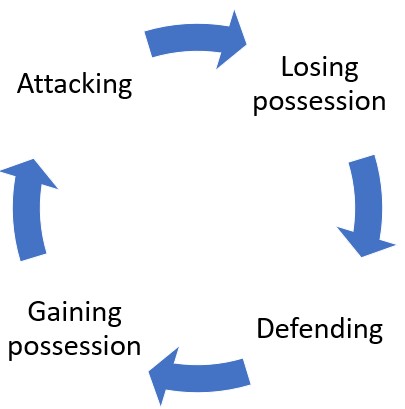
The four moments of football.

Football has four moments that keep occurring throughout a match.

These are; In possession, losing possession, out of possession and gaining possession.

These moments are separate and can only happen one at a time for a given team.

The best players that make it to the top level, know and understand how to behave in all these four moments.

In possession is attacking, out of possession is defending while gaining possession and losing possession are known as transitioning.

In possession: The team in possession of the ball is the attacking team. Players in the attacking team are expected to behave by applying the principles of attack and roles in attack.

The efficiency of an attack is determined by how well individual players in a team are comfortable at executing attacking football skills.

Out of possession: The team out of possession is the defending team. Successfully defending an attack in football requires individuals in the team applying the principles of defending and the roles of defending.

This requires the individuals being able to execute all football defending skills comfortably.

Transitioning: Losing or gaining possession happens at the same time.

As one team gains possession, the other team is losing possession.

The faster the transition, the better the outcome.

If a team gaining possession transitions faster than the team losing possession, then attacking will have the desired effect.

If a team losing possession transitions faster than the attacking team, then defending will have the desired effect.

Players with excellent football speed transition better.

The higher the level of football, the higher the demand to have better football speed to perform with quality during transitions.

Top teams in modern football are capable of transitioning under five seconds if the ball is won or lost at the halfway line.

It’s important for football coaches to ensure that players are taught how to comfortably execute all football skills irrespective of playing position because modern football dictates that every player gets involved in all the moments of football.

Football: Roles in defense.

When a team is not in possession of the ball, it’s the defending team.

All players in the defending team should be able to help out with defensive duties.

The roles in defense are; pressuring defender (first defender), covering defender (second defender) and the balancing defender (third defender).

Its important that football players are taught the roles of defending after understanding principles of defending.

Pressuring defender (first defender); this’ the player closest to the ball, the role of the first defender is to apply pressure on the ball.

Pressing the ball helps to delay the attackers by denying penetration, forces them into mistakes and if possible then wins the ball to regain possession.

The pressuring defender’s other roles include selecting the proper angle and speed of challenging for the ball.

Covering defender (second defender); this’ the player closest to the pressuring defender.

The second defender’s role is to offer cover to the pressuring defender.

The covering defender should always be positioned between the pressuring defender and the goal they are defending.

The distance has to be appropriate enough to enable the covering defender to react fastest to the ball in case the pressuring defender is beaten.

The covering defender should be able to communicate verbally with the pressing defender.

“A good defender is verbally loud.”

Balancing defender (third defender); The role of the third defender is to balance the defense by maintaining compactness or tracking attackers running off the ball.

The balancing defender should be able to maintain sight of the ball, have a clear vision of the whole pitch and to communicate verbally with the covering defender.

The roles performed by defending players are within the principles of defending. The pressuring defender performs immediate chase or delays the attacker. The covering defender offers depth while the balancing defender creates compactness.

It’s very important for all players to be capable of executing football defensive skills because at one point they will find themselves defending as a first, second or third defender.